Wrestling is an intense sport built off mental and physical strength. While strength is important, the mental game is what makes or breaks a match. Wrestlers have to use their mind to find out what combos, takedowns and positions that are the best for them in the moment. And with the Norwalk High Wrestling season underway, we’re here to provide a detailed guide to the sport so you can know whats going on in a wrestler’s head at your next match.
Basic Terms/Cheat Sheet
Pin: A move that automatically wins a match and earns 6 team points. This involves a wrestler holding their opponent’s shoulders blades/back down on the mat for 2 consecutive seconds.
Points: Points can be scored by many things. If during a match a pin cannot be secured, points are how the winner can be determined. Takedowns, reversals, back points (near falls), escapes (one point), and penalties by the other wrestler.
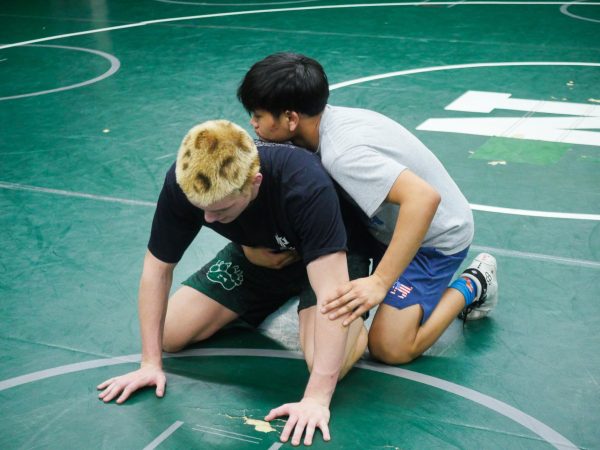
Top and Bottom: This position has the wrestler in control on the top, and the other on their knees and hands below the one in control.
Takedowns: A maneuver from neutral (standing position) where one wrestler takes control and forces their opponent onto the mat, typically receiving 3 points. Some popular takedowns are:
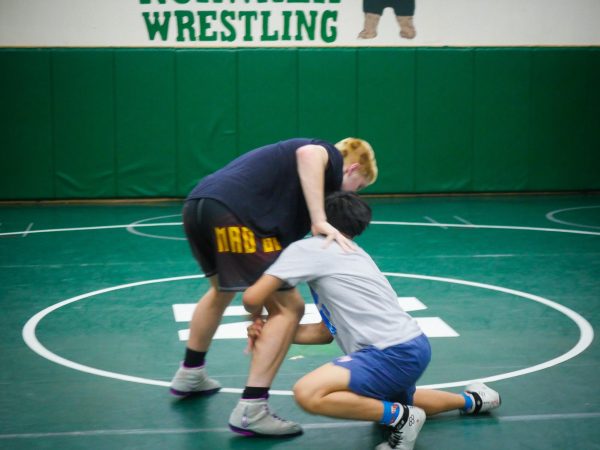
Single Leg – This involves grabbing one of the opponent’s legs and lifting or driving to take them down, leading to one wrestler in control.
Duck Under – The attacker pulls the opponent’s elbow, lowers their own head, and ducks under the arm to get behind the opponent.
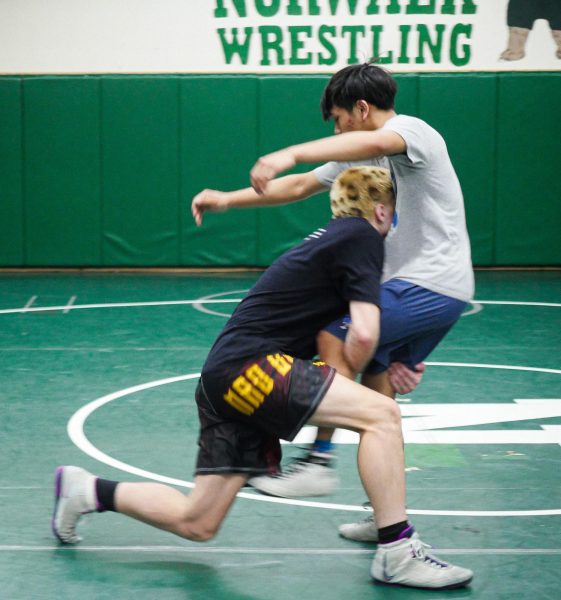
Double Leg – A foundational move involving lowering your level, grabbing both of the opponent’s legs, and driving forward to take them down.
Fireman’s Carry – A throw where the attacker pulls one of the opponent’s arms over their shoulder while holding a leg, then lifting and throwing the opponent over their body. (look at the gallery for picture)
These can result in points to win a match as well as lead to pinning the opposition.
In wrestling, it starts at the basic position, because that’s where balance and control come from. When they line up, their feet should be about shoulder-width apart with one foot slightly in front of the other. The wrestler’s knees stay bent and their weight should be on the balls of their feet, not flat-footed, so they can move quickly. Their back stays straight, heads up, and hands out in front of them ready to block or grab. This stance helps the wrestler stay low and strong, which makes it harder for their opponent to push them around or shoot in on their legs.
Point Breakdown: Wrestling matches are scored by earning points through control and position.
A One Point Escape – is worth one point and is earned when the wrestler on the bottom breaks free and gets away.
Near falls – are worth two, three or four points and happen when a wrestler almost pins their opponent by turning their shoulders close to the mat for a certain amount of time. Every second the blades are on the mat are how may points the wrestler can earn; up to four seconds.
Reversals – occurs when the wrestler who is on the bottom switches positions and ends up on top with control. A reversal is worth two points. It’s an important move because it can quickly change who has control in the match and shift the momentum.
Weight Classes: 106, 113, 120, 126, 132, 138, 144, 150, 157, 165, 175, 190, 215, 285 lbs.
Wrestling uses weight classes to keep matches fair and competitive. Instead of wrestling by height or age, wrestlers compete against others close to their own weight. This prevents stronger wrestlers from having an unfair advantage. In COED high school wrestling, weight classes usually start at lighter weights like 106 or 113 pounds and go all the way up to heavyweight, which is 285 pounds. Each weight class uses a different style. Lighter wrestlers tend to be faster and more agile, while heavier wrestlers rely more on strength and control. No matter the weight, every class takes just as much skill and effort to succeed.
Rules: rules are essential in any sport because they keep the players (or wrestlers in this case) safe. Some Illegal moves to watch out for are:
Clasping (locking hands) – a technical violation to lock or overlap hands, wrists, or arms around the opponent’s body or legs while on the mat in a control position without a near-fall/pin intention. (look at the gallery for picture)
Full Nelsons – a way of holding someone’s arm from behind with both of your arms and holding their neck with your hands, so that it is difficult for them to move. (look at the gallery for picture)
Slam-Like Takedowns – a takedown where a wrestler is lifting and bringing an opponent to the mat with unnecessary force.
Test Your Knowledge!
Wrestling is more than just strength. It’s technique, discipline, and strategy. From mastering the basic position, to understanding how points and reversals work, to competing in the right weight class, every part of the sport matters. Wrestling teaches focus, toughness, and confidence, both on and off the mat. It’s a sport where preparation shows, and effort always counts. Test your knowledge at your next wrestling match!